

The Flight Path to Real Estate Demand: Top and Bottom MSAs

Updated: Mar 23

Where Are People Actually Moving Before the Data Catches Up?
Before demand shows up in rents, sales, or absorption, it shows up somewhere else first: movement.
For real estate investors, understanding physical mobility is just as critical as tracking rent or absorption trends. To see where physical demand is actually moving before it hits the official reports, I calculated the 6 month average year over year passenger growth across the top 50 MSAs.
Because before capital moves, people do. This gives us two very different lenses into demand:
Domestic travel reflects business activity like property tours, deal flow, and corporate movement
International travel reflects global connectivity, talent inflow, and long term economic relevance
Here is how the markets with the highest and lowest mobility momentum look right now:
🛫 Business Mobility Signal: Domestic Travel
Domestic traffic is a practical read on business mobility, repeat site visits, and in-person deal flow across large metros.

📈 The Leaderboard: Top 5 MSAs
The strongest relative momentum in business mobility is clustering around the Sunbelt and select Midwest hubs.
Tampa, FL (+7.2%)
Nashville, TN (+6.6%)
Orlando, FL (+4.7%)
Chicago, IL (+3.5%)
Detroit, MI (+3.2%)
📉 The Watchlist: Bottom 5 MSAs
Conversely, markets with the slowest business mobility growth include several major convention and logistics hubs.
Charlotte, NC (down 5.7%)
Las Vegas, NV (down 6.8%)
Baltimore, MD (down 5.4%)
Philadelphia, PA (down 4.9%)
Dallas Fort Worth, TX (down 4.3%)
Brief Takeaway: Tampa and Nashville are continuing to solidify their business gravity, which translates directly into demand for office and multifamily spaces. Interestingly, major traditional hubs like Chicago are showing solid urban resilience. On the flip side, softness in Vegas suggests that pure business and convention mobility is cooling.
🛫 Business Mobility Signal: Domestic Travel
Domestic traffic is a practical read on business mobility, repeat site visits, and in-person deal flow across large metros.
📈 The Leaderboard: Top 5 MSAs
The strongest relative momentum in business mobility is clustering around the Sunbelt and select Midwest hubs.
Tampa, FL (+7.2%)
Nashville, TN (+6.6%)
Orlando, FL (+4.7%)
Chicago, IL (+3.5%)
Detroit, MI (+3.2%)
📉 The Watchlist: Bottom 5 MSAs
Conversely, markets with the slowest business mobility growth include several major convention and logistics hubs.
Charlotte, NC (down 5.7%)
Las Vegas, NV (down 6.8%)
Baltimore, MD (down 5.4%)
Philadelphia, PA (down 4.9%)
Dallas Fort Worth, TX (down 4.3%)
Brief Takeaway: Tampa and Nashville are continuing to solidify their business gravity, which translates directly into demand for office and multifamily spaces. Interestingly, major traditional hubs like Chicago are showing solid urban resilience. On the flip side, softness in Vegas suggests that pure business and convention mobility is cooling.
🌍 Gateway Signal: International Travel
International traffic is a read on gateway relevance: cross-border business links, overseas talent inflow, multinational connectivity, and tourism demand.
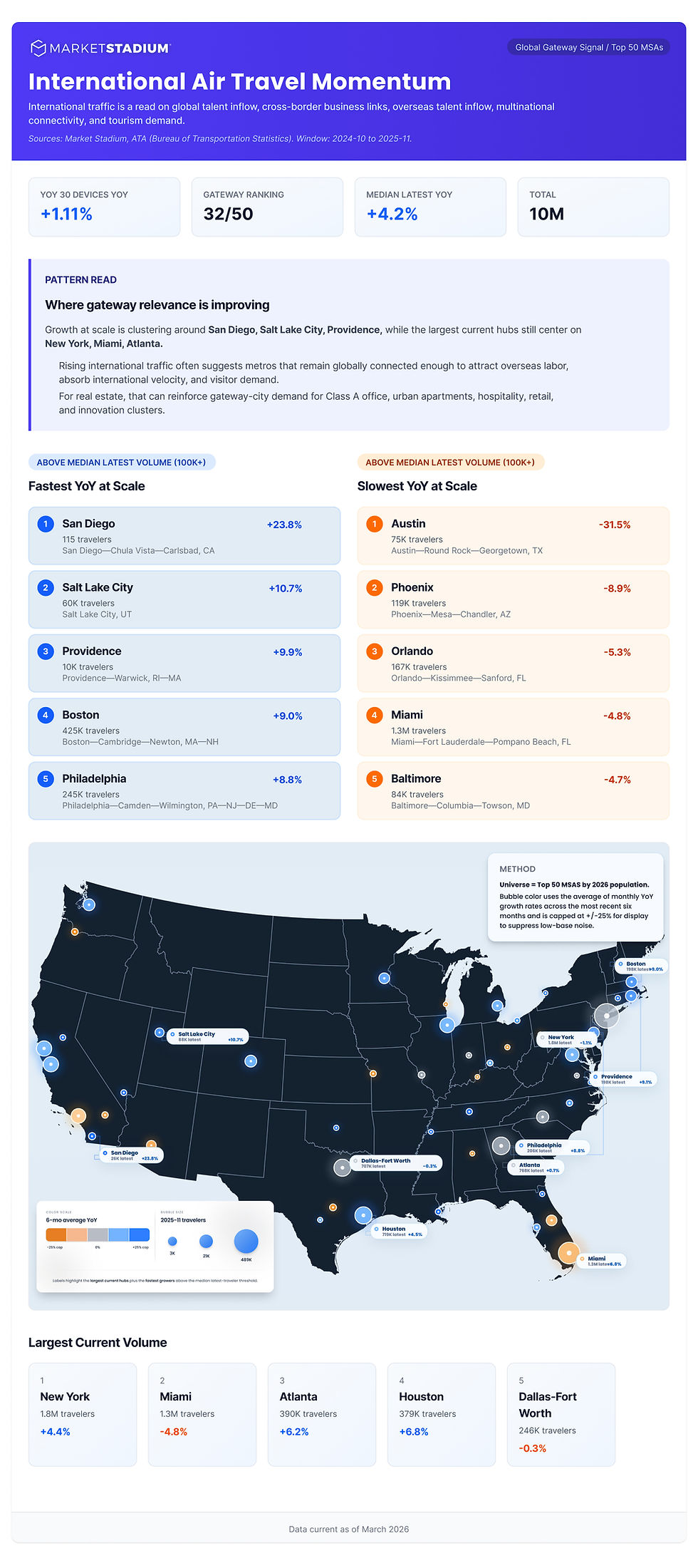
📈 The Leaderboard: Top 5 MSAs
Growth at scale is heavily concentrated in innovation hubs and specific coastal markets, indicating strong multinational connectivity.
San Diego, CA (+23.8%)
Salt Lake City, UT (+10.7%)
Providence, RI (+9.1%)
Boston, MA (+9.0%)
Philadelphia, PA (+8.8%)
📉 The Watchlist: Bottom 5 MSAs
Markets with the slowest international momentum are heavily located in the Sunbelt, regions that previously saw massive pandemic era booms.
Austin, TX (down 21.5%)
Phoenix, AZ (down 8.9%)
Orlando, FL (down 5.2%)
Miami, FL (down 4.8%)
Baltimore, MD (down 4.7%)
Brief Takeaway: San Diego is seeing an absolute surge, reinforcing its demand for Class A office spaces and urban apartments. The most surprising takeaway is Austin. The massive drop in international traffic suggests a significant cooling period for multinational tech expansions in the area.
Takeaway:
The data highlights a sharp divergence in where physical demand is heading. Before capital moves, people have to move. Tracking these flight paths provides a massive head start on understanding where the market is going next.
Keep an eye on these mobility metrics as you evaluate your next target market.
Want deeper analytical insights or submarket breakdowns? Click the Book Demo button in the top navigation bar for a personalized walkthrough.
Explore our Product page or walkthrough website anytime for more info on features we provide!

Dennis Lee
CEO at Market Stadium
Prev. Lionstone Investments Research Team




Comments