

Gentrifying Census Tracts by MSA: Where Upside Is Concentrating


Top MSAs — grouped into 5 tract archetypes
Gentrification doesn’t show up at the “city” level.
It shows up at the neighborhood (census tract) level — and it doesn’t look the same everywhere.
This week, we translated gentrification from a vague headline into tract-level signals by isolating gentrifying census tracts within each MSA and comparing them to the overall metro baseline.
Top MSAs — grouped into 5 tract archetypes
We built a “gentrifying-tract fingerprint” for each MSA using our full variable set, then grouped MSAs with similar fingerprints into five repeatable gentrification archetypes.
Variables used for clustering:
Built environment: Walk Score
Pricing: Multifamily Rent, Housing Value
Demographics: Median Age, Median Income, Education
Tenure: Owner Share, Renter Share
Cluster Breakdown (5 Archetypes)
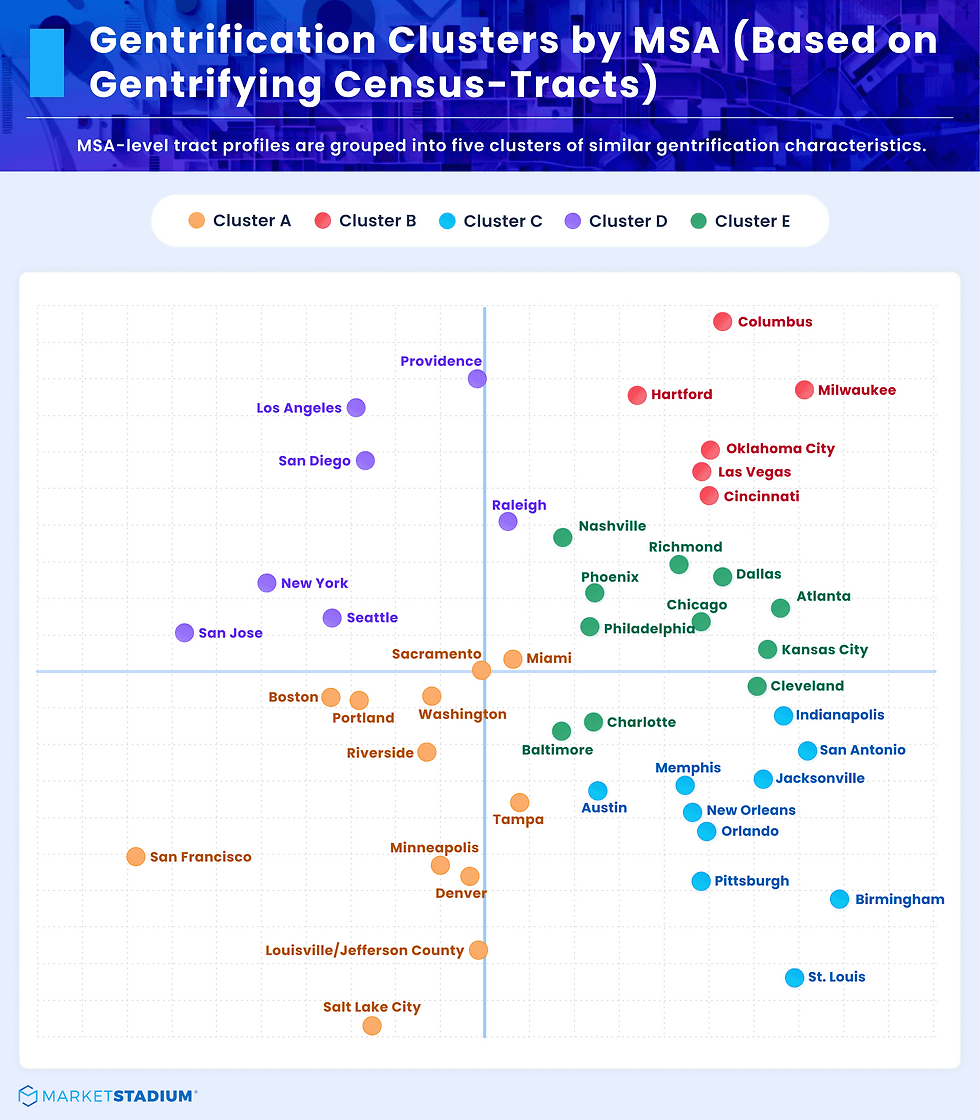
🔴 Cluster D — Rent-Accelerator Urban Core
Affordability deteriorating + stress rising
These markets show the strongest “gap widening” dynamics: price-to-income is projected to worsen quickly, and delinquency is already accelerating.
Examples: Austin, Dallas, Houston, Detroit, San Diego, San Jose
🟠 Cluster C — Value-Led Re-Rating
Stress-led warning
PTI growth is more moderate, but delinquency is rising—suggesting pressures may be coming from the labor market, debt burden, or localized shocks (not just affordability).
Examples: San Francisco, Seattle, Portland, Denver, Boston, Raleigh
🟢 Cluster A — Stable-Demand Upgrading
Stabilizing and resilient
Affordability pressure is building more slowly and borrower stress remains contained—typically the most “defensive” profile.
Examples: New York, Philadelphia, Miami, Minneapolis, Salt Lake City, Milwaukee
🔵 Cluster B — Early-Shift Renter Markets
Affordability risk building, stress not visible yet
PTI is projected to worsen quickly, but delinquency hasn’t moved much—often a “late-cycle” risk bucket if affordability keeps tightening.
Examples: Los Angeles, Chicago, Atlanta, Phoenix, Pittsburgh, Jacksonville
🟣 Cluster E — Expansion / Mixed-Tenure Growth
Affordability risk building, stress not visible yet
PTI is projected to worsen quickly, but delinquency hasn’t moved much—often a “late-cycle” risk bucket if affordability keeps tightening.
Examples: Los Angeles, Chicago, Atlanta, Phoenix, Pittsburgh, Jacksonville
Key Takeaways
Gentrification isn’t a single phenomenon—it’s five repeatable tract archetypes with different payoff mechanics:
Cluster D: rent-led upside (ops + repositioning)
Cluster C: value-led upside (basis + exit re-rating)
Cluster A: stable fundamentals (steady demand + durability)
Clusters B/E: transition/expansion types (higher dispersion → better selection matters)
Bottom line: Don’t underwrite gentrification off MSA averages.
Underwrite it by tract archetype, then pick micro-locations that match your strategy.
Want deeper quadrant insights or submarket breakdowns? Click the Book Demo button in the top navigation bar for a personalized walkthrough.
Explore our Product page or walkthrough website anytime for more info on features we provide!

Dennis Lee
CEO at Market Stadium
Prev. Lionstone Investments Research Team



Comments