

🌍 Where Climate Risk Concentrates Across U.S. Counties

With severe cold weather alerts popping up again across parts of the U.S., it’s a reminder that “climate risk” isn’t theoretical — it hits underwriting through insurance terms, capex volatility, and operational disruption.
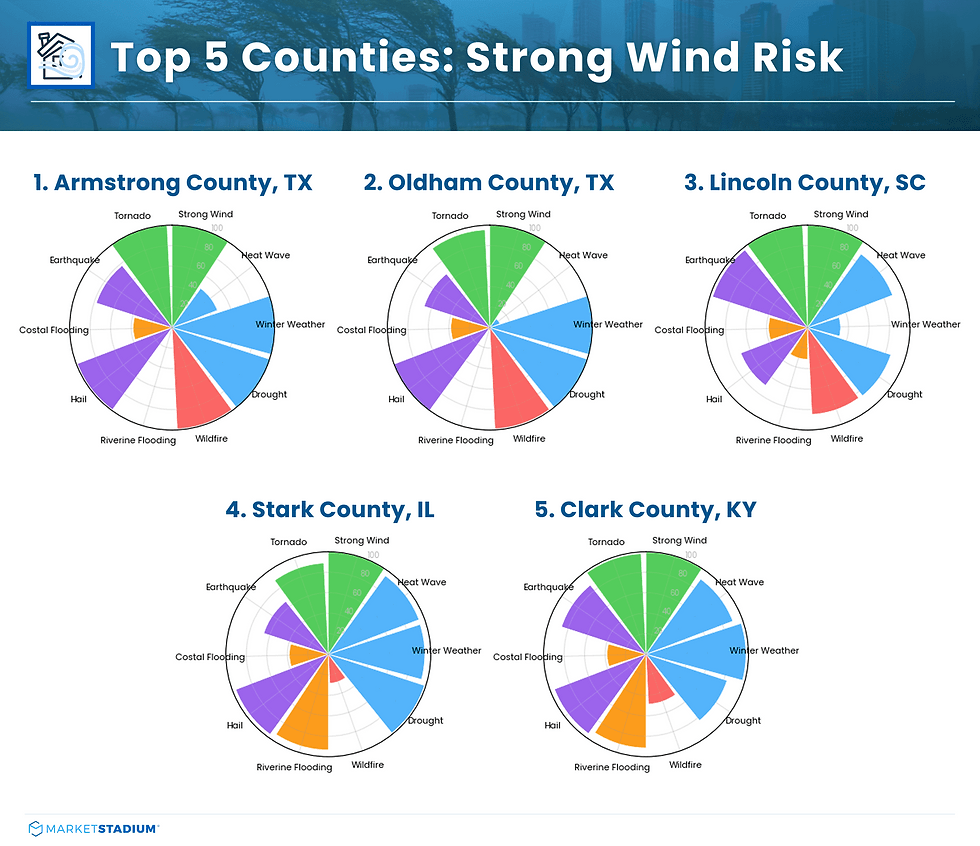
So we ranked the top 5 counties in the U.S. for each of 10 hazard types (based on risk score) to see where risk clusters most.

🟦 Group 1: “Cold + Wind” Shock Zones (Plains / Panhandle)
Counties like Armstrong, Oldham, Carson, and Potter (TX) repeatedly show up at the top across Winter Weather + Strong Wind (and often Hail too).
These are the markets where a single season can trigger stacked impacts: freeze disruption, roof damage, and insurance tightening at renewal.
🟧 Group 2: Heat-Load Markets (Midwest Corridor)
The St. Louis / central Missouri footprint (e.g., St. Louis County, IL and multiple MO counties) rises to the top for Heat Wave Risk.
This shows up less as a one-time event and more as NOI friction — utilities, HVAC wear, tenant comfort, and leasing performance.
🟨 Group 3: Long-Run Constraint Risk (Drought / Wildfire)
Texas dominates the top ranks for Drought, while Wildfire concentrates in West Texas with notable outliers like Boise County, ID and Baker County, FL.
Here, the swing factor is often insurability + rebuild economics, not just the hazard itself.
🟩 Group 4: Water-Driven Disruption (Riverine + Coastal Flooding)
Riverine flooding spikes in Central/East Texas (e.g., Wilson, Caldwell) with additional high-risk counties across NC/WV/IN.
Coastal flooding concentrates in Mid-Atlantic coastal counties (e.g., Somerset, DE; Talbot, MD; Mathews, NC).
Flood is the category where micro-location (elevation, drainage, access) can change the deal more than the metro narrative.
🟥 Special Case: California Risk Split
Earthquake risk is overwhelmingly California-led (Los Angeles, Alameda, Riverside, Santa Clara, San Francisco).
It’s not “multi-hazard everywhere” — it’s a structural underwriting variable that changes retrofits, financing terms, and insurance availability.
Takeaways
Climate risk isn’t one slider — it’s 10 different mechanisms that affect returns differently. The edge isn’t avoiding risk entirely; it’s knowing where risk concentrates and underwriting the right mitigation, reserves, and insurance structure accordingly.
Appendix


Want deeper insights or submarket breakdowns? Click the Book Demo button in the top navigation bar for a personalized walkthrough.
Explore our Product page or walkthrough website anytime for more info on features we provide!

Dennis Lee
CEO at Market Stadium
Prev. Lionstone Investments Research Team



Comments